
_edited.png)
Belmonte Castle and Old Town A Medieval Gem on Quijote’s Road

Some towns reveal themselves from a distance. Belmonte Castle and Old Town is one of them. Before you reach its narrow streets, you see the castle on the hillside, watching over the plain with the calm authority of a place that has seen centuries pass.
Set in the heart of Castilla-La Mancha, on the famous Ruta del Quijote, Belmonte combines literary memory, noble architecture and one of Spain’s most striking medieval fortresses. It is known as the birthplace of the Renaissance poet and scholar Fray Luis de León, but its identity stretches far beyond one famous name. The old town has been declared a Property of Cultural Interest, and the castle remains its great landmark.
This is a place where stone does most of the storytelling. Walls run down towards the town. Churches, palaces and traditional houses shape the historic centre. Above it all stands the 15th-century fortress that once sheltered Doña Juana la Beltraneja and later found a second life as a film location.

A town shaped by La Mancha and literature
Belmonte sits in a part of Spain where distance, sky and stone all matter. The surrounding land has the open quality associated with La Mancha, a region inseparable from the world of Cervantes and Don Quixote. The Ruta del Quijote links towns, roads and landscapes connected to that literary imagination, and Belmonte fits naturally into the journey.
The town is not a stage set. It is a real historic place with layers of power, faith, family lineage and rural life. Its streets climb and dip. Its façades carry coats of arms, ironwork and carved details. The scale is human, but the heritage is substantial.
Belmonte’s connection to Fray Luis de León adds a different kind of depth. Born here in the 16th century, he became one of the great figures of Spanish letters. His work belongs to the intellectual and spiritual world of the Renaissance, yet his birthplace anchors that legacy in a small Castilian town.
That mix gives Belmonte a special character. It is both literary and fortified, both intimate and monumental. Visitors often come for the castle, but the town rewards slower attention.
Belmonte Castle commands the hillside
The fortress is the clear star. Belmonte Castle sits on a hill above the town, placed for both defence and display. Its presence defines the skyline and gives the old town a dramatic upper edge.
Built in the 15th century, the castle reflects a moment when noble power needed architecture that could impress as much as protect. Its exterior has a distinctive pentagonal plan, with walls, towers and a Gothic entrance that frame the approach. From outside, it looks severe and controlled, yet the interior tells a richer story.
The castle is also linked to one of the most contested figures in late medieval Castile, Doña Juana la Beltraneja. Her name belongs to a period of dynastic tension and shifting loyalties, and Belmonte’s association with her adds political weight to the fortress. The building was not only a military structure. It was part of the theatre of power.
Today, the castle’s appeal comes from that blend of drama and detail. It is easy to understand why filmmakers have used it. Few places offer such a convincing medieval profile, with walls that still feel rooted in the landscape rather than separated from it.
For many travellers, Belmonte Castle and Old Town A Medieval Gem on Quijote’s Road is more than a descriptive phrase. It captures the way the town works as a whole. The fortress is impressive on its own, but it gains meaning from the streets, walls and countryside around it.

The castle interior rewards a closer look
The first impression of Belmonte Castle comes from its mass and outline. The deeper pleasure comes inside, where medieval craftsmanship becomes more visible.
The interior is organised around a triangular courtyard, a memorable contrast with the pentagonal exterior. This geometry gives the fortress an unusual rhythm. It feels planned, formal and slightly unexpected.
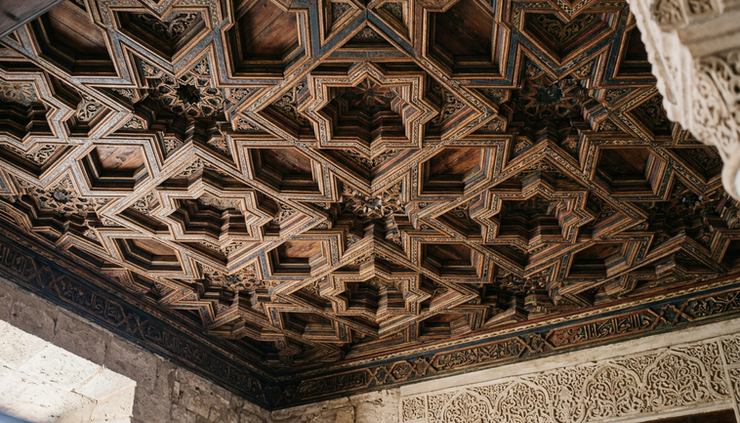
Among the highlights are the Mudéjar coffered ceilings, which show the artistic exchange that shaped much of Spain’s medieval architecture. Mudéjar work drew on Islamic decorative traditions within Christian-ruled territories, often producing woodwork, geometric designs and ornamental surfaces of great refinement.
The castle also contains plasterwork and Gothic reliefs. These details soften the martial character of the building. In a fortress, decoration can feel surprising, but it makes sense here. Castles such as Belmonte were places of status as well as security. They had to defend, but they also had to host, impress and declare identity.
Look for contrasts as you move through the rooms:
Heavy walls beside delicate carved surfaces
Defensive forms paired with ornamental ceilings
Narrow passages opening towards grander spaces
Stone austerity balanced by decorative craft
These contrasts help explain why the castle has such lasting appeal. It does not tell a single story. It speaks of fear, ambition, taste, conflict and prestige at once.
The old town is more than a backdrop
It would be a mistake to treat Belmonte’s old town as a supporting act. The historic centre has its own value, and its declaration as a Property of Cultural Interest recognises that broader importance.
The town has noble buildings, religious architecture and streets that still preserve a medieval and early modern atmosphere. The castle may dominate the visual field, but the old town gives context to everything above it.
Walking through Belmonte is a matter of noticing the details. A stone doorway. A shield on a façade. A quiet square. A view back up towards the fortress. The pleasure lies less in rushing from monument to monument and more in seeing how the town fits together.
The link between castle and settlement is especially important. The walls descend from the fortress towards the town, reminding visitors that this was once a connected defensive system. The castle was not isolated from everyday life below. It formed part of a larger protected space.
Belmonte’s historic streets also offer a more domestic side of heritage. Here, the grandeur of lineage and Church meets the practical shape of a Castilian town. The result feels lived in, not frozen.

Noble buildings and sacred spaces enrich the visit
Belmonte’s heritage is not limited to military architecture. The old town includes buildings that speak of noble families, religious life and civic importance.
The Collegiate Church of San Bartolomé is one of the major landmarks often associated with the town’s monumental character. Its scale and artistic value help balance the dominance of the castle. Together, church and fortress show the two great powers that shaped many medieval and Renaissance towns: faith and nobility.
The birthplace of Fray Luis de León adds another thread. It connects Belmonte to scholarship, poetry and the wider Spanish Golden Age. Even for visitors who do not know his work in detail, the association gives the town a literary dimension that suits its place on the Ruta del Quijote.
Belmonte is especially rewarding because these elements sit close together. You do not need to separate the “castle visit” from the “town visit”. They belong to the same experience. The route through the streets gradually leads the eye back to the hill, while the view from the castle helps explain the town’s shape.
That sense of relationship is one of Belmonte’s greatest strengths.
Why filmmakers keep returning to Belmonte
Belmonte Castle has appeared in numerous films, and it is easy to see why. Cinema needs places that can suggest another age without too much explanation. This fortress does that at once.
Its towers, walls and hillside setting create a powerful silhouette. The surrounding landscape adds openness and scale. The old stone surfaces carry the texture that modern sets often struggle to imitate.
A good film location is not only attractive. It must feel believable from different angles. Belmonte offers gates, courtyards, battlements, interiors and long views. Each area has its own visual character, yet all belong to the same coherent historic setting.
This screen presence has helped introduce the castle to wider audiences. Still, its fame as a location should not overshadow its real history. The building does not need cinematic association to be impressive. The films simply recognise what was already there.
How to experience Belmonte well
Belmonte is best approached slowly. The town is compact enough to explore on foot, but its setting rewards unhurried movement. Start by taking in the castle from below, then climb or make your way towards it, depending on your route and mobility.
Inside the castle, give time to the decorative details. The ceilings, plasterwork and reliefs are easy to miss if the focus stays only on towers and views. The exterior gives the fortress its drama. The interior gives it refinement.
In the old town, look for the relationship between streets and monuments. Belmonte’s charm comes from the whole composition, not just a single landmark.
A simple plan works well:
Begin with a walk through the historic centre.
Visit the main religious and noble buildings that fit your interests.
Continue to the castle and explore its exterior and interior.
Pause for the views over the town and surrounding countryside.
Return through the old streets to see the fortress from a different angle.
Comfortable shoes are a sensible choice, as the hillside setting and historic paving can make the visit more physical than it first appears. Light also matters. Early morning and late afternoon often bring out the colour of the stone and make the castle even more photogenic.
A medieval stop with real substance
Belmonte has the qualities travellers often hope to find in inland Spain: a strong sense of place, visible history, literary associations and architecture that has not lost its power. The castle draws the eye first, but the old town gives the visit depth.
Its position on the Ruta del Quijote adds romance, yet Belmonte does not rely on literary atmosphere alone. The 15th-century fortress, the hillside walls, the noble buildings and the memory of Fray Luis de León make it one of the most rewarding historic towns in Castilla-La Mancha.
The best way to remember Belmonte is as a conversation between height and street, defence and beauty, history and imagination. Stand below the castle and it looks like a medieval dream. Step inside and walk the town, and it becomes something better: a real place, built by ambition, shaped by art and still capable of surprise.


Comments