
_edited.png)
Weekend in Cuenca and the Natural Wonders Around It

Cuenca is one of those places that feels made for a short trip. In one weekend, you can stand on a medieval bridge with cliffs below your feet, walk past houses that seem to hang from rock, eat well in a quiet old town, and spend the next morning among limestone shapes that look almost invented.

The city is compact, but the province opens quickly into gorges, pine woods, lagoons, viewpoints, and strange geological formations. That makes it ideal for a two or three-day route: one day for the UNESCO-listed old town, one day for the Serranía de Cuenca, and a little extra time for a slower stop on the way in or out.
Start with the city that hangs over the gorges
Cuenca’s first impression is vertical. The old town sits high between the gorges of the Júcar and Huécar rivers, with viewpoints, narrow streets, and stone façades that make the city feel part fortress, part balcony.
A good weekend begins in the upper town, rather than at street level. If you arrive on Friday afternoon or Saturday morning, head towards the Plaza Mayor and let the route unfold on foot. This is the best way to understand the city’s scale. Streets climb, turn, and open suddenly onto ravines. A short walk can feel much bigger than it looks on a map.
Begin at Plaza Mayor and the cathedral
Plaza Mayor is the natural starting point. It is small, colourful, and framed by the Cathedral of Santa María and San Julián, one of the city’s great landmarks. The cathedral is known for its mix of styles and for being one of the earliest Gothic cathedrals in Spain, although later additions give it a layered look.
From the square, wander without rushing. Cuenca rewards slow movement. Look for small viewpoints, stone arches, and quiet corners where the city drops away towards the gorge. The old town is not large, but it is steep, so comfortable shoes matter more here than a detailed checklist.
Good stops around this area include:
The cathedral and its cloister, if open during your visit
The streets around Calle Alfonso VIII, known for its coloured façades
Small bars and bakeries where you can pause between climbs
Viewpoints facing the Huécar gorge
Cross to the Hanging Houses
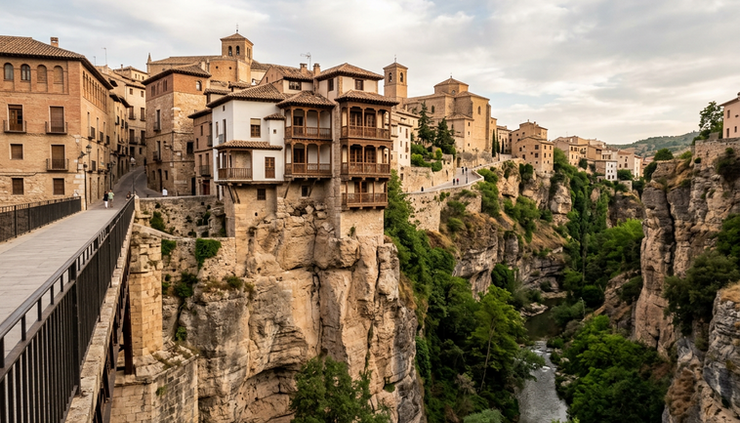
The Casas Colgadas, or Hanging Houses, are Cuenca’s best-known image for good reason. Their wooden balconies project over the cliff as if the buildings have grown from the rock itself. They are not just decorative either. They show how the city adapted to its dramatic site, using every edge and ledge available.
To see them well, cross the San Pablo Bridge. The bridge links the old town with the area of the former San Pablo Convent, now used as a parador. The crossing is safe, but it can feel thrilling if you are not fond of heights. Pause halfway and look back. From here, the Hanging Houses, the gorge, and the upper town all line up in one of the most recognisable views in Castilla-La Mancha.
If you have time, visit the Spanish Abstract Art Museum, housed inside the Hanging Houses. It adds a different layer to the city, especially if the weather turns or you want a break from walking.
Plan a relaxed route through Cuenca in one day
A full day in Cuenca is enough to see the essentials without turning the visit into a race. The key is to group stops by height. Start high, explore on foot, then descend when you are ready for food or a riverside walk.
Here is a simple route that works well:
Time | Plan |
Morning | Plaza Mayor, cathedral, upper town viewpoints |
Late morning | Hanging Houses and San Pablo Bridge |
Lunch | Traditional restaurant in the old town or lower city |
Afternoon | Walk by the Huécar or Júcar gorge, visit a museum, or return to viewpoints |
Evening | Sunset near the castle area or from the San Pablo Bridge |
For lunch or dinner, look for local dishes that match the mountain setting. Cuenca’s food can be hearty, with game, stews, mushrooms, and strong flavours. Morteruelo, a rich pâté-like spread, and ajoarriero, made with cod and potato, are two classic options. If you prefer something lighter, many places offer grilled meats, salads, and seasonal dishes.
The old town is atmospheric at night. Once day visitors leave, the streets become quieter and the lighting brings out the texture of the stone. If you stay overnight in or near the upper town, you can enjoy the city without needing to drive after dinner.
Spend the second day in the Serranía de Cuenca
The natural park around Cuenca is the reason this weekend works so well. In less than an hour by car, the city gives way to pine forests, cliffs, river bends, lagoons, and limestone formations. Public transport to these places is limited, so a car makes the route much easier.
The classic plan is to drive north-east from Cuenca towards the Serranía de Cuenca Natural Park. The roads are scenic, but they can be narrow and winding in places, so allow more time than the distance suggests. This is not a route to rush. The stops are close enough to combine, yet different enough to feel like a full day in nature.
Walk through the Enchanted City
The Ciudad Encantada, or Enchanted City, is one of the most famous natural sites near Cuenca. It is a landscape of limestone formations shaped over time by water, wind, and ice. Many rocks have names because their shapes resemble animals, objects, or human figures. You may see formations compared to a seal, a dog, a mushroom, or a bridge.
The marked trail is straightforward and suitable for most visitors, though the ground can be uneven. It is a good choice for families, photographers, and anyone who enjoys landscapes with a slightly surreal character. The best part is not ticking off each named rock. It is walking through a place where geology feels playful.
Try to visit early in the day if you can. The light is softer, the route is cooler in warm months, and the experience is calmer.
Stop at Ventano del Diablo
Not far from the Ciudad Encantada, the Ventano del Diablo offers one of the most striking viewpoints in the area. Its name means the Devil’s Window, and the view explains the drama. Natural openings in the rock frame the Júcar gorge below, with the river cutting through cliffs and forest.
This stop does not take long, but it is memorable. Take care near edges and keep to safe viewing points, especially if travelling with children. The rocks can be slippery after rain, and the drop is serious.

Continue to Uña and its lagoon
Uña is a small village set beside a peaceful lagoon, surrounded by cliffs and forest. After the drama of the rock formations and viewpoints, it offers a softer stop. You can walk near the water, have lunch, or simply sit and enjoy the change of pace.
The area around Laguna de Uña is good for birdwatching and gentle walking. It also gives a wider sense of the Serranía de Cuenca, where water, rock, and woodland constantly meet. If your weekend is about variety, this stop adds balance.
A practical second-day route could look like this:
Leave Cuenca after breakfast
Visit the Ciudad Encantada
Stop at Ventano del Diablo
Have lunch in Uña or another nearby village
Walk around Laguna de Uña
Return to Cuenca for dinner
If you prefer fewer stops, choose the Ciudad Encantada and Uña. That gives you both the iconic rock formations and a quieter natural setting without spending the whole day in the car.
Add one lesser-known natural stop if you have extra time
If your weekend stretches into a long weekend, or if you arrive early on Friday, add one more natural site. The province has many possibilities, but two stand out for a short route.
Visit Los Callejones de Las Majadas
Los Callejones de Las Majadas is another limestone landscape, but it feels different from the Ciudad Encantada. The formations create narrow passages, open clearings, and rocky corridors. It is often quieter, which makes it a strong choice if you want a more peaceful walk.
The paths are generally easy to follow, but as with any natural area, footwear matters. After rain, the ground may be muddy or slippery. Bring water, especially outside winter, because services are limited once you leave the villages.
Explore the Torcas de Palancares
South-east of Cuenca, the Torcas de Palancares offer a different geological surprise. These are large natural sinkholes, some filled with vegetation, formed in limestone terrain. The circular shapes are striking, and the area pairs well with a slower drive through pine woods.
This stop works well on the way into or out of Cuenca if your route comes from Madrid, Valencia, or other parts of central or eastern Spain. It also gives the weekend a broader view of the province, not just the famous northern route.
Both options show why the area around Cuenca is so rewarding. The city may be the headline, but the surrounding province keeps adding new textures.
Know what to pack and when to go
Cuenca has a continental climate, with hot summers, cold winters, and crisp shoulder seasons. Spring and autumn are especially pleasant for walking, sightseeing, and viewpoints. Summer works too, but plan nature walks early and carry enough water. In winter, the old town can feel wonderfully atmospheric, though ice, wind, or snow may affect rural roads and trails.
Pack for contrast. A weekend here may include cathedral visits, stone stairways, forest paths, and exposed viewpoints.
Bring:
Comfortable walking shoes with grip
Layers, especially outside summer
A refillable water bottle
Sun protection for open viewpoints and trails
A light waterproof jacket if rain is possible
A small daypack for nature stops
Driving also calls for patience. Distances may look short, but mountain roads slow the pace. Fill up with fuel before heading into quieter areas, and do not rely on every village having full services open at all hours.
If you are travelling without a car, focus on Cuenca city and nearby walks. You can still have a rich weekend by exploring both gorges, the upper town, museums, and viewpoints. For the deeper natural sites, a rental car or organised excursion will make the trip far easier.

A simple weekend itinerary that fits the best of Cuenca
This plan keeps the pace realistic while covering the city and the main natural highlights.
Friday evening
Arrive in Cuenca and settle in. If you have enough daylight, walk up to the old town for a first look at Plaza Mayor and the gorge viewpoints. Keep dinner close to your accommodation so you can enjoy the evening without rushing.
Saturday
Spend the day in Cuenca city. Start at Plaza Mayor and the cathedral, then walk towards the Hanging Houses and San Pablo Bridge. Leave the afternoon flexible for a museum, a riverside walk, or a second round of viewpoints. Stay for sunset if conditions are clear.
Sunday
Drive into the Serranía de Cuenca. Visit the Ciudad Encantada, stop at Ventano del Diablo, then continue to Uña for lunch and a gentle walk by the lagoon. Return to Cuenca or continue your journey home.
If you have Monday too
Add Los Callejones de Las Majadas or the Torcas de Palancares. Choose Las Majadas if you want more sculpted limestone and quiet paths. Choose Palancares if you prefer a stop that may fit better with your onward drive.
Why Cuenca works so well for a short escape
A good weekend trip needs contrast without chaos. Cuenca delivers exactly that. The city gives you history, architecture, dramatic streets, and memorable views in a compact area. The surrounding province adds forests, gorges, lagoons, and rock formations that feel far removed from urban life, even though they are close enough for a day out.
The best approach is to keep the plan simple. Give the old town enough time. Choose a few natural stops rather than trying to see everything. Leave space for a long lunch, an unplanned viewpoint, or a second look at the Hanging Houses in softer light.
With two days, Cuenca feels complete enough to satisfy. With three, it becomes a small adventure through one of inland Spain’s most distinctive corners. Either way, the cliffs, streets, and strange stone shapes are likely to stay with you long after the weekend ends.


Comments