

Lorca The Baroque City of Historic Monuments and Fortress Heritage

Lorca does not reveal itself through one grand monument alone. Its character comes from layers: prehistoric settlements, Roman traces, Islamic walls, mediaeval towers, Baroque palaces, convents, churches, cobbled streets, and a fortress that still dominates the skyline.
Declared a historic and artistic site in 1964, Lorca has earned its reputation as the “Baroque city” of south-eastern Spain. Yet its appeal goes far beyond Baroque architecture. This is a town where military power, noble pride, religious art, and everyday urban life all left clear marks on the streets.
Set in the Region of Murcia, Lorca rewards slow looking. A visitor can move from a monumental palace façade to a 10th-century gateway, then climb towards a fortress built over an older Arab alcazaba. The result is a historic centre that feels compact but unusually rich, with each period still visible in stone.

Lorca’s history is built in visible layers
Lorca has been inhabited since very early times, and its location helps explain why. The town sits in a strategic position between inland routes and the Mediterranean world. That made it attractive to different peoples over many centuries.
The remains around Lorca point to settlement and occupation from the Palaeolithic period through to the Roman era and beyond. Archaeological sites in and around the municipality show how deep this history runs. Rather than belonging to one single age, Lorca is best understood as a place where cultures succeeded one another, reused existing structures, and added their own marks.
The Roman presence can be read through remains such as the Roman milestone, a small but powerful reminder of road systems, movement, and administration. Roman milestones were not decorative pieces. They measured distance and marked the reach of authority. In a town like Lorca, this kind of object connects the local story to a wider Mediterranean network.
Later, under Islamic rule, Lorca became an important fortified settlement. The old defensive system included walls, gateways, and high points of control. Some of these structures were later adapted after the Christian conquest, giving the town its layered military identity.
That pattern of reuse matters. Lorca was not rebuilt from scratch in each age. New powers often reshaped what already existed. This is why a walk through the city can feel like reading a palimpsest, with older lines still visible beneath later designs.
The fortress is Lorca’s great landmark
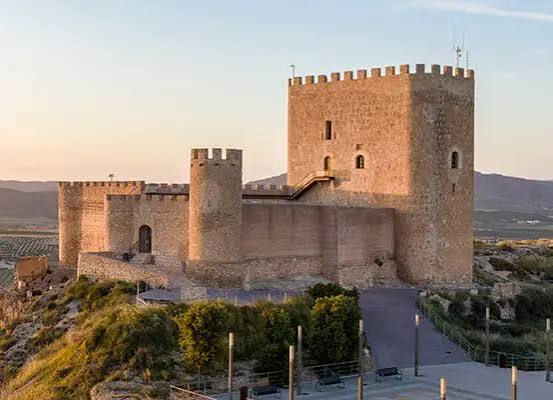
The fortress of Lorca is the town’s most commanding monument. It rises above the urban centre and gives the city a dramatic profile from almost every approach. Its scale alone makes it memorable, but its history is what gives it real force.
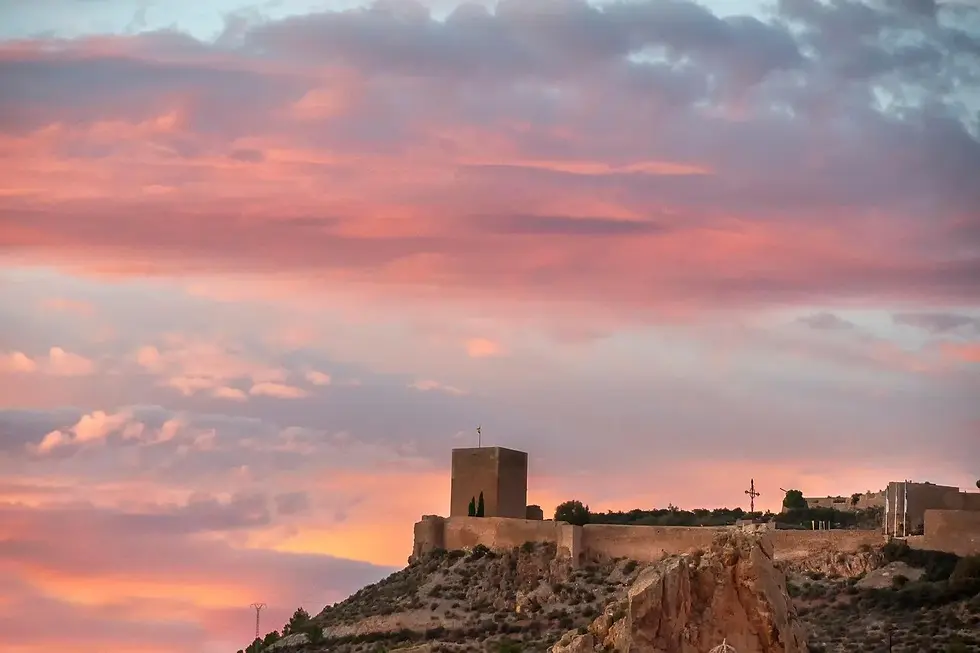
The fortress restructured the earlier mediaeval Arab alcazaba, turning an already strong defensive site into an almost impregnable stronghold. Its position allowed control over the surrounding territory, roads, and approaches to the town. For centuries, this was not only a place of refuge. It was a statement of power.
Two important towers form part of Lorca’s military heritage: the Espolón Tower and the Alfonsina Tower. Their names are closely tied to the town’s mediaeval history, and they help explain why Lorca’s fortress was more than a simple castle. It was a calculated defensive complex.
The Espolón Tower has a stern, military presence, while the Alfonsina Tower carries associations with the Christian reorganisation of the fortress after the conquest. Together, they show different stages in the building and adaptation of the site.
From the fortress area, the relationship between town and landscape becomes clear. Lorca was not just protected by walls. It was placed to watch, to control, and to endure. That sense of command still shapes the visitor’s experience today.
A visit to the fortress also changes how the historic centre below is seen. The palaces, churches, houses, and streets are not isolated monuments. They sit within the long shadow of a defensive system that shaped the town’s fortunes.
The old walls still speak through the porch of San Antonio
Among Lorca’s most evocative historic remains is the porch of San Antonio, a 10th-century gateway in the old city walls. It is one of those places where the past feels direct because the function is so easy to understand. This was an entrance, a point of passage, and a point of control.

Gateways have a special power in old towns. They divide inside from outside, safety from danger, civic order from open territory. The porch of San Antonio preserves that sense of threshold. It reminds visitors that Lorca once had a more enclosed form, shaped by walls and defended points.
The survival of this gateway matters because town walls often disappear as cities expand. Stones are reused. Openings are widened. Defensive lines become ordinary streets. In Lorca, the porch of San Antonio keeps a vital piece of the old urban structure visible.
It also helps connect the town’s Islamic past with its later Christian and Baroque identity. The historic centre is not a single-style museum. It is a city where mediaeval, religious, military, and noble architecture stand close together.
That closeness is one of Lorca’s strengths. A visitor does not need to travel far to move between centuries. The city’s story unfolds in short walks, sudden views, and small changes in stone, scale, and ornament.

Baroque Lorca is shown in palaces and noble houses
Lorca is known as the Baroque city because some of its most admired buildings belong to this richly expressive period. The Baroque style found a natural home in a city of noble families, religious institutions, and civic ambition.
The Palace of Guevara is one of Lorca’s finest Baroque landmarks. Its façade shows the confidence of an elite household that wanted architecture to communicate status. Baroque design often used movement, decoration, and theatrical detail to create impact. In Lorca, those qualities appear in carved stone, strong entrances, heraldic display, and carefully composed elevations.

The Palace of the Condes de San Julián is another key example of aristocratic architecture in the town. Buildings like this were not only private homes. They were public statements. Their façades faced the street, speaking to neighbours, visitors, and rivals.
The house of the Mula family also belongs to this world of distinguished domestic architecture. Together, these palaces and mansions show how Lorca’s historic centre developed as a place of power and refinement, not only defence.
Baroque Lorca is especially interesting because it does not stand apart from the older city. Noble façades appear near narrow streets, churches, convents, and remains from earlier periods. This creates a strong contrast between ornamented civic pride and the heavier military architecture above.
The Baroque layer also gives Lorca warmth and variety. Fortress walls may dominate at a distance, but the palaces reward close attention. Their details are best seen on foot, at the pace of someone willing to pause at doorways, balconies, coats of arms, and carved stonework.
Churches and convents add another layer of artistry
Lorca’s religious architecture reflects different eras and styles. The town contains churches and convents that contribute to its historic character, not only as places of worship but also as works of architecture and urban memory.
These buildings help show how Lorca grew after the mediaeval period. Religious orders, parish life, patronage, and civic ceremony all shaped the town’s streets. Churches often became anchors for neighbourhoods, processions, and public gatherings.
The variety of styles matters. Lorca does not present one neat architectural period. Its churches and convents record change over time, including Gothic, Renaissance, Baroque, and later influences, depending on the building and its history.
This mixture makes the city valuable for anyone interested in how architecture develops through use. Buildings were restored, altered, expanded, or reinterpreted. A church might preserve an older plan while presenting a later façade. A convent might carry traces of changing religious and social needs.
The result is a historic centre where sacred architecture plays a key role in the town’s visual rhythm. Towers, portals, chapels, and convent walls break up the streets and frame views towards the larger monuments.
For Lorca The Baroque City of Historic Monuments and Fortress Heritage, the religious buildings are essential. They connect artistic ambition with daily devotion, civic identity, and the long public life of the town.
Plaza de España reveals Lorca’s civil architecture
The area around Plaza de España is one of the best places to understand Lorca as an urban centre rather than a collection of separate monuments. The square and nearby streets form a civic heart, where public, religious, and domestic architecture meet.
The cobbled streets of Zapatería and Cava are especially important for the atmosphere of the old town. These are not only routes between famous buildings. They are part of the historic fabric itself. Their scale, surfaces, and alignments help preserve the feeling of an older city.

Civil architecture in Lorca deserves as much attention as the major monuments. Ordinary-seeming façades can reveal how people lived, traded, moved, and represented themselves. Balconies, doorways, corner buildings, and street widths all help shape the experience of the historic centre.
Plaza de España also shows how Lorca’s civic life developed around shared spaces. In many Spanish towns, the main square became a stage for ceremony, government, religion, trade, and social encounter. Lorca follows that pattern while keeping its own local character.
Walking around this part of town gives a useful contrast with the fortress. Above, the military city speaks of defence. Below, the streets around the square speak of administration, society, worship, and daily life.
The best way to experience this area is without rushing. Look up often. Lorca’s details are not always at eye level. Cornices, windows, shields, and rooflines help tell the story as much as the main entrances.
How to explore Lorca without missing its character
Lorca is best understood through a route that joins its layers rather than treating each monument as a separate stop. A good visit should include the fortress, the old walls, the Baroque palaces, the churches and convents, and the streets around Plaza de España.
A simple way to think about the town is by height and history:
Upper Lorca
Walled Lorca
Baroque Lorca
Civic Lorca
The fortress, towers, defensive views, and the legacy of the alcazaba.
The porch of San Antonio and the memory of the mediaeval city.
Palaces, mansions, noble façades, and religious architecture.
Plaza de España, Zapatería, Cava, and the streets of everyday urban life.
This approach helps avoid a common mistake. Lorca should not be seen only as a castle town or only as a Baroque town. Its value lies in the way these identities overlap.
For a first visit, begin in the historic centre, where the details of the Baroque city are easiest to appreciate on foot. Then move towards the remains of the walls and the porch of San Antonio. After that, climb or travel up to the fortress to see the town from above. The view gives context to everything below.
Comfortable footwear helps, especially on cobbled streets and steeper routes. The historic centre rewards wandering, but many of its best impressions come from uneven ground, narrow lanes, and changes in level.
Take time for smaller features too. A Roman milestone, a gateway, or a quiet façade may not compete with the fortress in scale, but each one adds meaning. Lorca’s strength is cumulative.

Why Lorca’s heritage still feels distinctive
Many historic towns have castles, churches, or noble houses. Lorca stands out because it combines them in a remarkably clear way. The town’s identity rests on three strong pillars: defence, artistry, and continuity.
The fortress gives Lorca its defensive drama. The Baroque palaces bring elegance and urban pride. The older remains, from archaeological traces to the porch of San Antonio, give depth. Together, they create a town that feels historically complete.
Its recognition as a historic and artistic site in 1964 was not based on one monument alone. It reflected the value of the wider historic centre and its unusually rich collection of remains. That designation still makes sense today. Lorca is a place where architecture does not simply decorate the city. It explains it.
The town also shows how heritage survives through adaptation. The Arab alcazaba became a reworked fortress. Mediaeval walls gave way to later neighbourhoods, but fragments remained. Noble families added Baroque grandeur to an older urban frame. Each age changed Lorca, yet none completely erased what came before.
That is why Lorca rewards more than a quick stop. It asks for attention to sequence, material, and setting. The fortress is grand, but the smaller streets complete the story. The palaces impress, but the gateway gives them deeper context. The churches stand as monuments, but they also form part of the town’s lived structure.

Lorca is a city to read slowly
Lorca’s historic centre is not just attractive. It is unusually legible. The town allows visitors to see how power, faith, wealth, defence, and daily life shaped the same urban space across centuries.
The fortress tells of strategic control. The Espolón and Alfonsina towers speak of military strength and adaptation. The porch of San Antonio preserves the memory of walls and guarded entrances. The palaces of Guevara and the Condes de San Julián, along with the house of the Mula family, show the confidence of Baroque Lorca. The churches, convents, Plaza de España, Zapatería, and Cava complete the picture with civic and religious life.
The best takeaway is simple: Lorca should be experienced as a whole city, not as a checklist of monuments. Walk it from the streets to the heights, and its long history becomes clear in stone.


Comments