
_edited.png)
Mindful Grounding for Solo Nomad life on the Open Road

Solo nomad life can bring peace, but it can also stir loneliness, decision fatigue, homesickness, doubt and a kind of low hum in the nervous system. Every day asks for choices. Where will I sleep? Is this place safe? Do I have enough water? Why do I feel flat when this is the life I wanted?
The first night in a van feels bigger than the vehicle itself. Every cupboard, curtain, mug and blanket seems to carry a promise: leave when you want, wake somewhere new, make the road your rhythm.
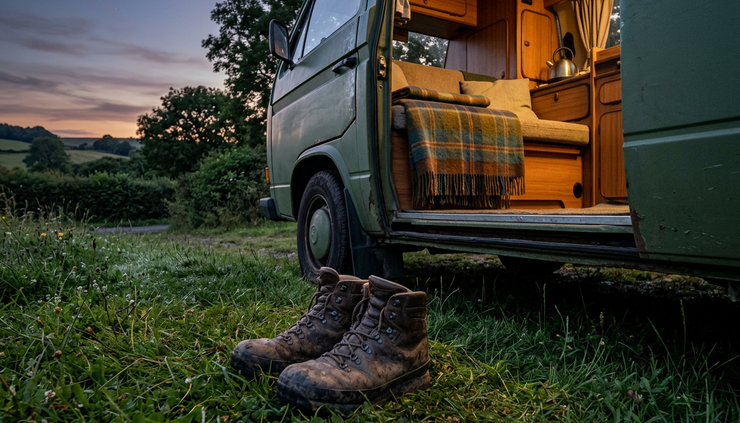
When I brought my mat-green Peugeot Boxer, Alma, home and parked her outside my door, the feeling was almost electric. I could picture empty beaches, slow mornings, coffee with the side door open, and the strange thrill of not needing to be anywhere by Monday.
Then the quieter truth arrived.
Freedom does not remove pressure. It changes its shape.
True slow travel asks for more than route planning. It asks for emotional steadiness, gentle self-awareness and small grounding habits that can travel with you.

The emotional shift begins before the journey does
A mobile life often starts with a burst of activity. Sorting possessions, planning storage, fixing leaks, learning electrics, cooking on one hob, choosing insurance, finding the right bedding for cold nights. The practical list is loud, so it can drown out the emotional one.
Then, when the engine finally turns over and the old structure falls away, feelings rise.
Some are joyful. There is space, choice and novelty. Simple acts feel new again. Boiling water becomes part of a ritual. Parking near trees feels like an event. The first morning somewhere unfamiliar can feel like a quiet celebration.
Other feelings can be harder to name.
A fixed home gives shape to the week. The same shop, the same walk, the same kettle in the same kitchen. Once those anchors move, the mind can search for replacement points. That search can feel like restlessness, even when nothing is wrong.
This is one of the hidden emotional transitions of van life and solo travel. The outer life expands, while the inner life tries to find a new centre.
A helpful question is not, “Why am I not happy all the time?”
A better question is, “What part of me is still catching up?”
That gentler question leaves room for adjustment. It also removes some of the shame that can appear when a dream life feels difficult.
Freedom can create decision fatigue
Solo nomad life and travel give you full control, which sounds ideal until every decision belongs to you
You choose the route, the pace, the parking spot, the food, the budget, the laundry day, the repair plan, the next country lane, the next conversation and the next quiet night. There is nobody beside you to say, “Let’s stop here,” or, “I’ll check the map.”
That level of choice can drain energy. The mind starts to treat small decisions as safety checks.
A simple grounding method is to reduce the number of daily choices before the day begins.
Try creating a few gentle defaults:
A simple breakfast you can make without thought
A preferred arrival time at overnight spots, ideally before dark
A small list of trusted parking apps or map tools
A weekly laundry and water refill rhythm
A basic evening routine that stays the same wherever you are
Defaults are not restrictions. They are supports. They let the mind rest.
When life is mobile, steady routines become portable walls. They create just enough shelter to help you relax.

Grounding begins with the body
When people talk about mindfulness, it can sound abstract. On the road, grounding needs to be practical. It must work in a lay-by, a campsite shower block, a ferry queue or a rainy supermarket car park.
The body is the fastest doorway back to the present.
When anxiety rises, the mind often moves into prediction. It scans for what could happen next. The body can interrupt that loop by returning attention to what is happening now.
Try these simple practices.
Name what is solid
Place both feet on the floor of the van, the ground or the grass. Press your toes down. Notice the weight of your heels.
Then name five solid things around you.
The steering wheel. The seat. The mug. The door handle. The floor.
This sounds almost too simple, but it helps the brain locate itself. Solid objects remind the body that the present moment is real and specific.
Use water as a reset
Water is one of the easiest grounding tools for nomads because it already matters so much. You track it, refill it, save it and heat it.
Turn washing your hands into a pause. Feel the temperature. Notice the sound. Slow down the movement.
If you have safe access to a stream, sea edge or lake shore, stand still and listen for a minute. Do not turn it into a performance. Just let the senses have something simple to hold.
Breathe without making it complicated
A steady breath can settle the nervous system, but forced breathing can sometimes make stress worse. Keep it soft.
Try this:
Inhale naturally through the nose
Exhale a little longer than the inhale
Repeat for one minute
Stop if it feels uncomfortable
The aim is not to become perfectly calm. The aim is to create enough space to make the next choice.
This article offers reflective wellbeing guidance only. If distress feels intense, persistent or unsafe, professional support matters.
Make loneliness a signal, not a verdict
Solo travel does not always mean loneliness, but loneliness does visit most people eventually. It can appear in beautiful places, which makes it feel even stranger.
You may be parked beside a mountain, watching the sky change colour, and still feel a sharp ache for familiar voices. That does not mean you chose the wrong life. It means you are human.
Loneliness is information. It may be telling you that you need:
A proper conversation
Familiar music or food
A rest from moving
Time in a town rather than another remote spot
A message to someone who knows your history
A few days around other travellers
The temptation is to treat loneliness as failure. A more useful response is to treat it as a request for connection.
Build connection before you urgently need it. Send voice notes instead of perfect updates. Arrange regular calls with one or two trusted people. Spend time in places where small conversations happen naturally, such as independent cafés, campsites, bookshops, community markets or walking routes.
Connection does not always have to be deep. Sometimes a warm exchange with a shopkeeper, another van owner, or someone walking their dog can soften the edge of a day.

Build an inner check-in before you check the map
Navigation apps can tell you the fastest route, the nearest fuel station and the next overnight stop. They cannot tell you whether you are tired, overstimulated or travelling to avoid sitting with a feeling.
Before opening the map each morning, try a two-minute inner check-in.
Ask:
What is my body asking for today?
What emotion is most present?
Am I moving from curiosity, pressure or avoidance?
What would make today feel kind?
What is the smallest sensible next step?
These questions do not need long written answers. A few words are enough.
For example:
Body Heavy, needs stretching
Emotion Tender, slightly anxious
Movement Pressure, not curiosity
Kindness Short drive, hot food, early stop
Next step Find water, then choose a nearby place
This practice helps separate movement from escape. Travel can be a beautiful way to meet life, but it can also become a way to outrun discomfort. The difference is often felt in the body. Curiosity feels open. Avoidance feels tight and urgent.
A grounded nomad does not stop moving. They learn to notice why they are moving.
Create a van ritual that means home
A vehicle like Alma can become more than transport. It becomes shelter, kitchen, wardrobe, bedroom and thinking space. The transition from house to van becomes easier when the van has sensory cues that mean “safe enough”.
The ritual can be tiny.
Light a battery lantern at dusk. Put the same blanket over your knees. Play one quiet playlist while cooking. Sweep the floor before bed. Make tea in the same cup after parking. Say out loud, “I’m here for the night.”
Repetition matters. Over time, the body begins to recognise the pattern.
A good evening grounding ritual might look like this:
Park while there is still light
Check the surroundings once, not repeatedly
Close curtains or blinds
Put keys in the same safe place
Make a warm drink or simple meal
Write three lines in a journal
Stretch the neck, shoulders and hips
Dim lights before sleep
The goal is not to control every variable. Road life will always include weather, noise, delays and the occasional bad parking choice. The goal is to give yourself a reliable return point.
Home can become an action rather than an address.
Learn the difference between discomfort and danger
Solo nomads need both courage and caution. The challenge is knowing which one a moment requires.
Discomfort can sound like:
I feel awkward arriving alone
I do not know anyone here
This unfamiliar place makes me nervous
I feel silly eating by myself
I miss my old bed
Danger can sound and feel different:
Someone is watching or approaching in a way that feels intrusive
The parking spot has poor exits
Local signs or rules make it clear you should not stay
Your body gives a strong, specific alarm
The area feels unsafe after a basic arrival check
Mindfulness should never be used to talk yourself out of reasonable caution. If a place feels wrong, leave. You do not need to justify the decision, and you do not need a dramatic reason. Starting the engine is a valid grounding practice.
At the same time, not every flutter of nerves is a warning. Some are signs of newness. With time, you learn your own signals. Journalling can help because patterns become clearer on paper.
You might notice that you feel uneasy every time you arrive hungry, or that you make poor decisions after driving too late. You might learn that busy car parks unsettle you, while remote spots soothe you, or the other way round.
Self-knowledge is part of safe travel.
Let slow travel change your pace inside as well
Slow travel is often described in terms of distance. Fewer miles. Longer stays. Local food. Wandering without rushing. All of that matters.
Yet the deeper pace shift happens internally.
If you have lived for years by alarms, deadlines and busy calendars, your mind may keep moving at that speed even when your van is parked under trees. The body may be still while the thoughts race ahead.
This is where mindful grounding becomes less of a technique and more of a relationship with yourself.
You begin to notice the impulse to move on. You pause before filling silence. You let a place reveal itself over days rather than demanding wonder on arrival. You stop measuring the journey only by views, photos or pins on a map.
A grounded road life leaves room for ordinary days. Laundry days. Rain days. Tired days. Days when the best thing you do is empty the bin, refill the water, cook pasta and sleep early.
Those days are not interruptions. They are part of life.
The open road is not a cure for being human. It offers space, and space tends to show us what we carry. With kindness, structure and attention, that space can become a place of deep steadiness.
Bring the map, the tools, the spare fuses and the warm socks. Bring curiosity too. Most of all, bring a willingness to meet yourself without rushing away.
The horizon outside will keep changing. The inner one can become a little steadier each time you stop, breathe, listen and choose the next small mile.
Comments