
_edited.png)
Getting Around Spain: High-Speed Rail, Buses, and Urban Transit

Spain looks large on a map, then the transport network starts shrinking it. Madrid to Barcelona becomes a morning train ride. A village in Andalucía can sit within reach of a regional bus. A city break in Valencia, Bilbao, Seville, or Madrid can run smoothly without a car.
That is the quiet pleasure of travelling through Spain. The country rewards both planners and wanderers. High-speed rail links major cities at pace, buses fill the gaps, and urban transport systems make local movement simple. Add scenic backroads for rural detours, and Spain becomes less like a country to cross and more like a playground to explore.

Spain is built for connected travel
Spain has one of Europe’s strongest long-distance transport networks. The main routes radiate from Madrid, which makes the capital a useful hub even when it is not the final destination. From there, fast trains go towards Barcelona, Valencia, Seville, Málaga, Alicante, Zaragoza, Córdoba, and other major cities.
That does not mean every trip should pass through Madrid. Coastal routes, regional buses, local trains, and domestic flights can make more sense depending on the itinerary. The best approach is to match the transport to the kind of Spain being explored.
For a simple trip, such as Madrid, Seville, and Barcelona, trains are usually the easiest option. For smaller whitewashed towns, mountain villages, beach coves, and national parks, buses or a hire car may work better. For islands, ferries and flights enter the picture.
A useful rule is this:
Use trains for speed between big cities, buses for reach, and city transit for daily movement.
That combination covers most journeys without stress.
High-speed rail turns long distances into easy days
Spain’s high-speed rail network is the star of intercity travel. Trains are fast, frequent on common routes, and usually take passengers from city centre to city centre. That alone can save time compared with flying, especially once airport transfers and security queues are included.
The national operator Renfe runs AVE high-speed services, along with other long-distance and regional trains. On some key routes, private operators also run services, including low-cost options. This has made popular corridors more competitive, particularly between major cities.
When the train is the best choice
The train makes sense when travelling between large or mid-sized cities. It is especially strong for:
Madrid to Barcelona
Madrid to Seville or Córdoba
Madrid to Valencia or Alicante
Madrid to Málaga
Barcelona to Zaragoza or Madrid
For these routes, rail travel feels calm and direct. Stations are usually central or well linked by metro, bus, tram, or taxi. There is no need to arrive hours early, and luggage rules are often more forgiving than airline restrictions.
Book ahead for the best fares, especially on busy routes, Friday evenings, Sunday returns, public holidays, and summer travel periods. Prices can rise closer to departure, and the cheapest ticket types may have limited flexibility.
Choosing between train types
Not every train in Spain is a high-speed train. The names matter:
Train type | Best for | What to expect |
AVE and other high-speed services | Fast travel between major cities | Quick, comfortable, usually reserved seating |
Long-distance trains | Routes not fully covered by high-speed rail | Slower than AVE but still useful |
Media Distancia | Regional travel between towns and cities | Good for shorter intercity journeys |
Cercanías and Rodalies | Commuter routes around major cities | Practical for airports, suburbs, and nearby towns |
The local names can vary by region. Around Barcelona, the commuter rail network is often referred to as Rodalies. Around Madrid and other areas, Cercanías is the common term.
Station tips that make rail travel easier
Spanish railway stations range from compact local stops to large terminals such as Madrid Atocha and Barcelona Sants. For high-speed routes, passengers may pass through a light security check before boarding. It is not like airport security, but it does mean arriving a little early helps.
Keep the ticket handy, either printed or on a phone. Check the departure board for the platform, known as the vía. At larger stations, the platform may appear only shortly before boarding.
A small food bag and water bottle are also useful. Many long-distance trains have catering, but not every service offers the same choice.
Buses go where trains do not
Buses are the quiet workhorses of Spanish travel. They connect towns, villages, coastal resorts, and rural areas that trains may not reach. In some parts of Spain, the bus is not just a backup option, it is the main public transport link.
Long-distance coaches can be comfortable, with reserved seats and luggage storage. ALSA is one of the best-known operators, but local and regional companies also run many routes. In some autonomous communities, transport may be organised through regional networks, so the booking process can vary.

When buses are the smarter option
Choose a bus when the destination is a small town, a rural base, or a coastal area without good rail links. Buses are also useful for cross-country routes where the train connection would require a long detour.
They can be slower than trains, but that is not always a disadvantage. A bus ride through the mountains of Asturias, the plains of Castilla, or the olive groves of Andalucía gives a sense of distance and terrain that high-speed rail can blur.
Buses can also be better for budgets. On some routes, coach fares are lower than train tickets, especially if booked in advance.
What to check before booking
Bus stations are usually called estación de autobuses. They are not always next to railway stations, so check the location before choosing a connection.
Before booking, look at:
The departure station and arrival station
Total journey time
Whether the route is direct
Luggage allowance
The final bus of the day
Weekend or public holiday schedules
On rural routes, services may be limited. A timetable that looks easy on a weekday may not work on a Sunday. If the trip depends on one specific bus, confirm the schedule close to travel.
Urban transit makes city travel simple
Spanish cities are generally easy to navigate without a car. Madrid and Barcelona have extensive metro networks. Valencia, Bilbao, Seville, Málaga, Palma, and other cities offer combinations of metro, tram, bus, suburban rail, or local trains.
The best urban transport is often the one that avoids traffic. In Madrid and Barcelona, the metro is usually the fastest way to cross the city. Buses help with neighbourhoods that the metro does not serve. Trams are useful in cities such as Valencia and Bilbao, especially for certain districts and beach routes.
Madrid
Madrid’s metro is one of the most useful systems in Europe for visitors. It links central areas, residential districts, major train stations, and the airport. For sightseeing, it works well alongside walking, because many central neighbourhoods sit close together.
A good rhythm is to use the metro for longer jumps, then walk between nearby areas such as Sol, Plaza Mayor, Gran Vía, Retiro, and the museum district.
Barcelona
Barcelona combines metro, bus, tram, and suburban rail. The grid layout of the Eixample makes walking easy, while the metro helps connect places such as the Gothic Quarter, Sagrada Família, Montjuïc, Gràcia, and beach areas.
Some popular sights sit on hills or away from the centre, so public transport can save energy. For Park Güell, Montjuïc, and Tibidabo, check routes carefully rather than assuming the nearest metro stop is the easiest approach.
Smaller cities
In cities such as Seville, Granada, Córdoba, San Sebastián, and Salamanca, walking plays a larger role. Historic centres often have narrow streets, shaded squares, and limited car access. Local buses, taxis, and trams can help, but the most rewarding route is often on foot.
For urban travel, contactless payment and ticket cards vary by city. Some places allow bank card tap-in, while others use dedicated travel cards or paper tickets. Check the local system after arrival rather than assuming one method works everywhere.

Driving opens the scenic gaps
Public transport covers a remarkable amount of Spain, but a car can transform certain trips. It is especially useful for national parks, remote beaches, hill towns, wine regions, and mountain roads.
Driving is not needed inside big cities. In fact, a car can become a burden in Madrid, Barcelona, Seville, Valencia, Bilbao, and similar places. Parking is limited, old quarters can be confusing, and some areas have access restrictions. The smarter plan is often to take the train between cities, then hire a car for a specific rural section.
Routes where a car can shine
A car can make sense in places such as:
The Picos de Europa and rural Asturias
The white towns of Andalucía
The Costa Brava beyond the main rail-linked towns
Inland Galicia and the Rías Baixas
La Rioja wine country
Parts of Extremadura
Mountain villages in Aragón or Catalonia
This is where the “logistics of discovery” becomes real. High-speed trains shrink the long distances, then scenic backroads slow the trip down again in the best way. A morning train can bring the journey close to a region, and a car can handle the last, beautiful stretch.
Driving tips for Spain
Motorways are generally good, and major roads are well maintained. Some motorways have tolls, while others are free. Rural roads can be narrow, winding, and slow, particularly in mountain areas.
A few practical habits help:
Keep cash or a card ready for parking and possible tolls.
Do not rely only on mobile signal in remote areas.
Check whether accommodation includes parking.
Avoid driving into historic centres unless necessary.
Learn basic road terms such as salida for exit and peaje for toll.
For city-to-city travel, the train is often easier. For village-to-village exploring, a car can be priceless.
Airports and ferries fill in the wider map
Spain’s mainland transport network is strong, but the country also includes island groups and far-flung coastal links. The Balearic Islands, including Mallorca, Menorca, Ibiza, and Formentera, need flights or ferries. The Canary Islands require a flight from mainland Spain, with ferries between some islands.
Domestic flights can also make sense for very long journeys, such as northern Spain to the south, or mainland Spain to the islands. Still, for many mainland routes, the train competes well once total travel time is considered.
Ferries are useful for island travel and some coastal crossings. They are slower than flights, but they allow a different pace and may suit travellers with vehicles.
How to plan a smooth multi-city route
A strong Spain itinerary usually combines transport types rather than relying on one. The trick is to avoid zigzagging across the country. Spain rewards regional logic.
For example, a southern route might link Madrid, Córdoba, Seville, Granada, and Málaga. A north-eastern route might connect Barcelona, Girona, Figueres, and the Costa Brava. A northern route could focus on Bilbao, San Sebastián, Santander, Oviedo, and smaller coastal towns, using a mix of buses, trains, and car hire.
Think in clusters. Spain is easier when grouped into regions:
Region | Good bases | Useful transport |
Central Spain | Madrid, Toledo, Segovia | High-speed rail, regional trains, buses |
Andalucía | Seville, Córdoba, Granada, Málaga | Trains, buses, selective car hire |
Catalonia | Barcelona, Girona, Tarragona | High-speed rail, regional trains, buses |
Basque Country | Bilbao, San Sebastián, Vitoria-Gasteiz | Buses, trains, urban transit |
Galicia | Santiago de Compostela, A Coruña, Vigo | Trains, buses, car hire for rural areas |
Valencia region | Valencia, Alicante | Trains, trams, buses |
When planning, map the order before booking. A journey that looks short geographically may take longer if mountains or poor connections sit between two points. Direct routes matter more than straight-line distance.
Practical ticket habits that save time
Good transport planning does not need to be complicated. A few habits make a big difference.
Book long-distance trains early when travelling on popular routes. Compare departure times, journey length, luggage rules, and ticket flexibility.
Use official operator sites or trusted booking platforms. If a price looks unusually high or the route seems odd, compare it elsewhere before paying.
Leave connection time between different operators. A late bus and a separate train ticket can create problems if the connection is tight.
Check station names carefully. Some cities have more than one major station. Madrid, Barcelona, Valencia, and other cities can require a metro or taxi transfer between stations.
Travel lighter than you think you need to. Spain’s stations often have escalators and lifts, but not always where they are needed. Small luggage makes buses, stairs, cobbled streets, and hotel check-ins much easier.
Save tickets offline. Mobile coverage is usually good, but station Wi-Fi and roaming can fail at the worst moment.
The best way to move through Spain
There is no single best transport option in Spain. The best choice changes with the journey.
Travel goal | Best option |
Fast travel between major cities | High-speed train |
Reaching smaller towns | Bus |
Exploring a city | Metro, tram, bus, and walking |
Visiting rural areas | Hire car |
Island travel | Flight or ferry |
Keeping costs low | Advance bus or train tickets |
The real strength of Spain is how well these options fit together. A trip can begin with an AVE train from Madrid, continue by regional bus to a smaller town, unfold on foot through a historic centre, then finish with a rented car on a quiet country road.
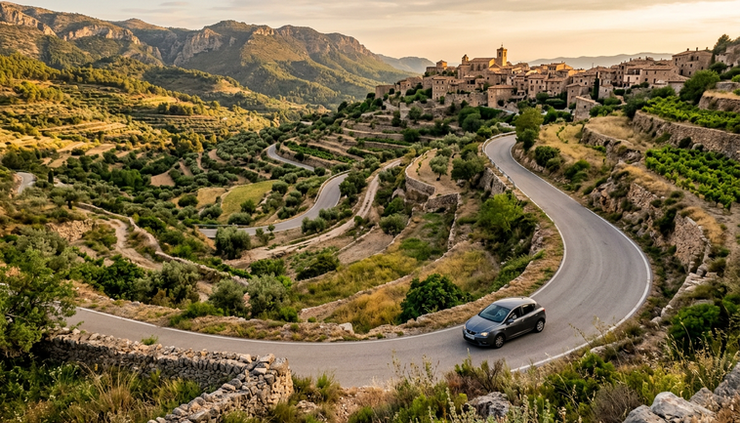
Spain rewards travellers who mix speed with patience
Getting around Spain is efficient and straightforward, but the best journeys leave room for contrast. Let high-speed rail handle the long distances. Let buses carry the trip into less obvious places. Use urban transit to move easily through each city. Save the car for roads where the view is part of the reason to go.
That balance turns a large country into something manageable without making it feel small. Spain is not only crossed. It is connected, layered, and ready to be discovered one well-chosen route at a time.


Comments