
_edited.png)
Spanish Etiquette Essentials for 2026: Master the Unwritten Rules

Spain is easy to enjoy, but not always easy to read. The welcome is warm, the meals are long, the evenings stretch late, and the real rhythm of the day often starts when visitors think it should be winding down.
These Spanish etiquette essentials will help make your travel through Spain smoother, kinder, and much more enjoyable.
The trick is not to memorise a rulebook. It is to tune in. Spanish etiquette lives in timing, tone, personal warmth, and a shared respect for the social moment. A quick coffee can become a conversation. Lunch can take over the afternoon. Dinner at 10 pm is normal in many places. And after the plates are cleared, nobody rushes off, because the sobremesa may be the best part of the meal.

The Spanish day runs on its own clock
Visitors often notice the late dinners first. What takes longer to understand is the whole rhythm behind them.
In Spain, the day tends to stretch later than in northern Europe. Lunch is often the main meal, especially at weekends or with family. Dinner may be light and late. In summer, when the heat lingers, streets can feel quiet in the afternoon and come alive in the evening.
That does not mean everything is casual or disorganised. Spain has punctual trains, busy offices, booked tables, school runs, medical appointments, and normal daily pressures. The difference is that social time often has a wider margin.
If someone says to meet at 8 pm for drinks, that may mean drinks before dinner, not the meal itself. If a restaurant looks empty at 8.30 pm, it may simply be early. In some cities, especially Madrid, Seville, Valencia, Málaga, and Barcelona, the busiest dinner window can begin closer to 9.30 pm.
Good etiquette starts with flexibility. Avoid judging the timing as “late” or “slow”. Treat it as part of the culture’s pace.
A few practical habits help:
Check kitchen hours before assuming you can eat at any time.
Book popular restaurants, especially from Thursday to Sunday.
Do not expect a long lunch to end quickly.
Leave space in the day for pauses, heat, queues, and conversation.
Learn whether a local plan means coffee, drinks, tapas, or a full meal.
The more you adapt to the clock, the less you feel stuck waiting for Spain to adapt to yours.
Greetings are warm, but read the room
Spanish greetings tend to be more physical than British ones, though the setting matters.
Friends and relatives often greet with two kisses, one on each cheek. These are usually cheek-to-cheek air kisses rather than dramatic kisses. In more formal situations, a handshake is still common. Among younger people, a wave, hug, or casual “hola” may be enough.
If unsure, pause for half a beat and follow the other person’s cue. That tiny pause avoids awkwardness.
Use greetings when entering small shops, cafés, lifts, or shared waiting rooms. A simple “hola” or “buenos días” goes far. When leaving, “gracias” and “hasta luego” are polite even if you do not know the person.
Spanish conversation can sound lively. People may overlap, interrupt lightly, gesture, laugh loudly, or stand closer than expected. This is not usually rude. It often means engagement. Silence, by contrast, can feel colder than intended.
Still, warmth does not erase boundaries. Spain is diverse, and individuals vary. Some people prefer distance, especially in crowded public transport or formal settings. Let context guide you.
Useful greetings include:
Spanish phrase | When to use it | Meaning |
`Buenos días` | Morning until lunchtime | Good morning |
`Buenas tardes` | Afternoon and early evening | Good afternoon |
`Buenas noches` | At night, arriving or leaving | Good evening or good night |
`Perdón` | Getting attention or apologising | Sorry or excuse me |
`Gracias` | Any polite exchange | Thank you |
The small words matter because they soften daily interactions. Spain is sociable, but it is not careless.

Master the art of the sobremesa
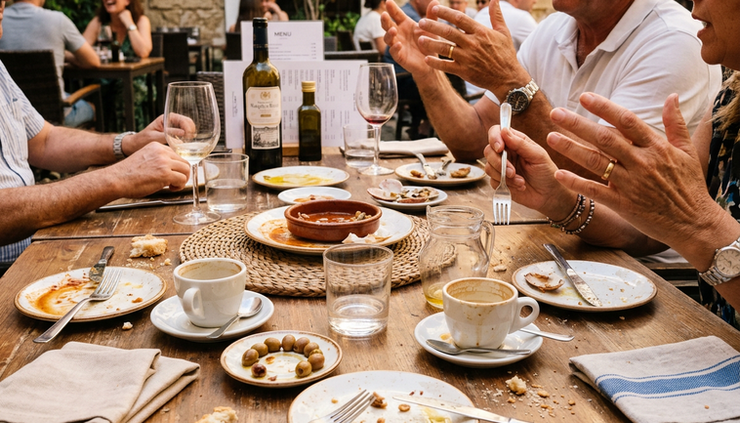
The sobremesa is one of Spain’s great social rituals. The word refers to the time spent lingering at the table after a meal, talking, laughing, sipping coffee, or doing very little in the best possible way.
It is not an afterthought. It is part of the meal.
At a family lunch, sobremesa can last longer than the food itself. At a restaurant, especially on weekends, people may stay at the table after dessert. Nobody asks for the bill the second the final fork drops. If you are invited to a home, do not leap up to leave as soon as eating ends unless your host clearly signals the gathering is over.
This is where visitors sometimes misread the moment. In some cultures, efficiency shows respect. In Spain, lingering can show appreciation.
That does not mean you should occupy a busy restaurant table for hours when others are waiting. Context matters. In a crowded city restaurant with a visible second sitting, staff may need the table back. At a relaxed Sunday lunch, rushing off can feel abrupt.
What to do after the meal
If you are sharing a long meal, stay present. Put the phone away unless everyone is using theirs. Join the conversation where you can. If your Spanish is limited, listening still counts.
When you do need to leave, do it warmly rather than suddenly. Say you have enjoyed the meal, thank the host, and avoid looking impatient.
If you want the bill in a restaurant, ask for it. Staff in Spain may not bring it until requested, because dropping the bill early can seem like pushing people out.
Use:
`La cuenta, por favor.`
It means, “The bill, please.”
How to handle shared food
Tapas, raciones, and family-style dishes invite sharing. Do not claim one dish as your own unless it has been ordered that way. Take modest portions at first. Use serving cutlery when provided, and avoid double-dipping.
Bread is common and often placed directly on the table or small plate. It is used to accompany food, mop sauces, and fill gaps, not usually treated as a separate course.
If someone pours wine or water for the table, a simple thanks is enough. Heavy toasting is not required, though “salud” is always welcome.
Tipping is appreciated, not theatrical
Tipping in Spain is much more restrained than in countries where staff rely heavily on tips. Good service deserves appreciation, but large tips can feel unnecessary in normal settings.
For a coffee, leaving small change is fine. For a casual meal, rounding up or leaving a few euros works if service was good. In a smarter restaurant, a larger tip may be suitable, but it still does not need to be extravagant.
Do not make a performance of it. Leave it discreetly on the table, add it by card if the machine allows, or tell the server the total you would like to pay.
Card payments are widely accepted, especially in cities and tourist areas. Still, small bars, markets, village bakeries, buses, or kiosks may prefer cash or have card minimums. Carry coins and small notes.
The same understated approach applies to complaints. Spanish service can be direct. A waiter may not hover, smile constantly, or check in every few minutes. That does not mean they are ignoring you. If you need something, catch their eye and ask politely.
Public space has its own quiet rules
Spanish streets can be lively, but public etiquette still matters.
On public transport, offer seats to older people, pregnant passengers, disabled passengers, or anyone who looks as if they need one. Keep bags off seats when crowded. Speak at a reasonable volume, especially late at night in residential streets.
In cities with heavy tourism, patience goes a long way. Locals may feel tired of blocked pavements, loud groups, and people treating everyday neighbourhoods like stage sets. Step aside before checking maps. Do not stop suddenly in narrow lanes. Avoid photographing people at close range without permission.
At beaches, parks, and plazas, cleanliness matters. Use bins, avoid leaving cigarette ends, and respect local signs. Some beaches have rules about dogs, smoking, music, or ball games. They are not decorative.
Queuing can look looser than in Britain, but order still exists. In bakeries, markets, pharmacies, and small shops, people often ask “¿Quién es el último?” meaning “Who is last?” The person who answers is before you. You then know your place without a visible line.
That one phrase can save a lot of confusion.
Dress with ease, but avoid looking careless
Spain is stylish in a practical, everyday way. People dress for the setting. Beachwear belongs at the beach, not in churches, restaurants, supermarkets, or city streets far from the sand.
In coastal resorts, standards are more relaxed, but walking shirtless through town or entering a café in swimwear can still be seen as rude. In churches, cover shoulders and avoid very revealing clothes. At smarter restaurants, clean, neat clothing is safer than ultra-casual wear.
This does not mean dressing formally. It means looking like you noticed where you are.
For city sightseeing, comfortable shoes matter. Spanish pavements, old-town cobbles, hills, and long evening walks can punish flimsy footwear. The best outfit is one that lets you move, sit, eat, and adapt.
A scarf, light shirt, or extra layer can help with churches, air-conditioned trains, and late-night temperature shifts.
Home invitations call for generosity and pace
Being invited to someone’s home is a warm gesture. Treat it with care.
Arrive close to the agreed time, but do not arrive very early. A slight delay is usually less awkward than catching the host unprepared. Bring something small, such as wine, chocolates, pastries, or flowers. If there are children, a small treat can be thoughtful, but check with the adults before handing over sweets.
Compliment the food without overdoing it. If a host insists you eat more, they may mean it warmly rather than forcefully. You can accept a little, or decline kindly with thanks.
Do not start clearing plates aggressively unless invited. Offering help is polite. Taking over the kitchen is not.
If the gathering runs late, that may be normal. Spanish hospitality often unfolds slowly. Watch the host’s energy, not the clock alone.
Regional differences matter
There is no single Spanish personality. Etiquette shifts across regions, cities, islands, languages, and generations.
Catalonia, the Basque Country, Galicia, Andalusia, Madrid, the Balearics, the Canaries, Valencia, and rural Castile all have their own rhythms. Local languages may be part of daily life. In Catalonia, Catalan appears alongside Spanish. In the Basque Country, Basque may appear on signs. In Galicia, Galician is common. In Valencia, Valencian is widely seen and heard.
You do not need fluency in every language. Respect is enough. Learn basic greetings where relevant, pronounce place names with care, and avoid reducing Spain to flamenco, paella, bullfighting, or beaches. Those things belong to specific histories and regions, not the whole country in one neat package.
Food customs also vary. Paella is strongly associated with Valencia and is traditionally a lunchtime dish. Pintxos culture is central in places such as San Sebastián and Bilbao. Late-night tapas in Granada will feel different from a seafood lunch in Galicia.
Ask, observe, and let each place be itself.

A few behaviours to avoid
Most etiquette mistakes are forgiven when the intention is good. Still, some habits cause friction.
Avoid these if you want to move smoothly through Spain:
Treating meal times as a problem to fix.
Shouting in residential streets after a night out.
Assuming everyone speaks English.
Touching produce in markets without checking the custom.
Rushing restaurant staff when the place is full.
Wearing beach clothes away from the beach.
Blocking pavements for photos.
Talking about regions as if they are all the same.
Expecting shops to follow British opening patterns.
Calling the sobremesa wasted time.
That last point matters. To understand Spain, understand the table after the meal. People stay because the relationship matters. The conversation matters. The pause matters.
The real rule is to slow down and pay attention
Spanish etiquette is not about performing Spanishness. It is about respect, warmth, and timing.
Say hello when you enter. Say goodbye when you leave. Make room in the day for long meals and late evenings. Ask for the bill when you are ready. Carry a little cash. Dress for the setting. Learn a few words. Let regions surprise you. And when the meal ends, resist the urge to stand up at once.
Stay for the sobremesa when the moment allows. That is where the unwritten rules become clear, and where Spain often feels most generous.


Comments