
_edited.png)
Things to Do in Castilla La Mancha Medieval Cities, Windmills and Hidden Gems

Castilla-La Mancha is the Spain of stone streets, sunburnt plains, cliff-hanging towns, and windmills that still look ready to tilt at giants. It sits just south and east of Madrid, yet it often feels far from the country’s busiest routes. Things to Do in Castilla-La Mancha is part of its appeal.
This is a region where medieval lanes drop toward river gorges, Renaissance squares host theatre under the stars, and dark slate villages sit hidden in mountain folds. The famous Don Quixote scenery is real, but it is only one layer. Beyond the windmills, you will find turquoise lagoons, lavender fields, cave houses, bird-rich national parks, and some of the most atmospheric small towns in inland Spain.
If you are looking for the best Things to Do in Castilla La Mancha Medieval Cities, Windmills and Hidden Gems, start with the classics, then give yourself time to wander.

Start with Toledo, where every street feels layered
Toledo is one of Spain’s great historic cities, and it earns the attention. Set on a hill above the Tagus River, it has the kind of skyline that looks built for slow arrivals. The cathedral rises over a maze of narrow streets. The Alcázar watches from above. Old synagogues, churches, small patios, and stone gateways tell the story of a city shaped by Christian, Jewish, and Islamic cultures.
The best way to see Toledo is not to rush from monument to monument. Walk early, before the day-trippers arrive, and let the streets do their work. The old town rewards aimless turns. A lane that seems to lead nowhere may open onto a quiet square, a viewpoint over the river, or a shop selling damascene metalwork.
The cathedral is the major landmark, with a vast interior and centuries of art and architecture inside. The Alcázar, rebuilt over time, adds a more imposing note to the skyline. For a different mood, cross to one of the viewpoints outside the old town and look back at Toledo from across the Tagus. At sunset, the stone turns warm and the city looks almost suspended above the river.
Good to know
Wear shoes with grip. Toledo’s lanes are steep and polished in places.
Stay overnight if you can. The city changes after the tour buses leave.
Do not try to “finish” Toledo in a few hours. Choose a few key sights and leave space for wandering.
Walk the edge in Cuenca
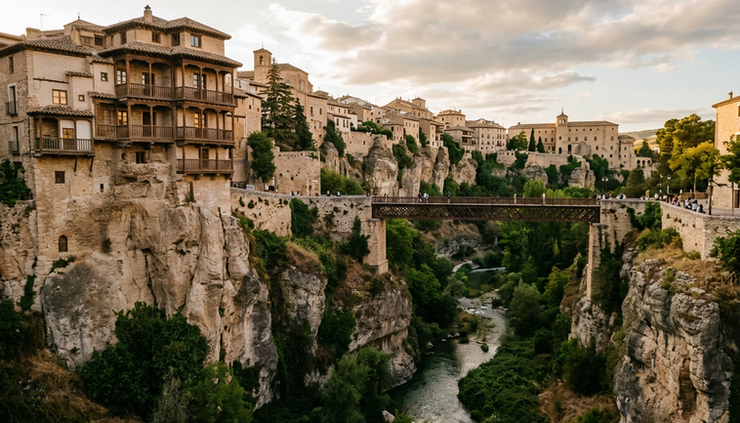
Cuenca has one of the most dramatic settings in central Spain. Its medieval core sits between deep gorges carved by the Júcar and Huécar rivers. The famous Hanging Houses, or Casas Colgadas, cling to the rock above the drop, with wooden balconies leaning out over the void.
The old town climbs sharply, so take your time. The reward is a sequence of views that shift with every bend. From the bridge of San Pablo, the Hanging Houses have their classic profile. From the upper streets, you see tiled roofs, pale stone, and cliffs falling away beneath the city.
Cuenca is not only about the view. Its cathedral, quiet lanes, small museums, and cliffside walks make it a strong overnight stop. The city feels medieval, but not frozen. Students, cafés, and contemporary art spaces give it a lived-in energy.
For a wilder side of the area, visit the nearby rock formations of the Ciudad Encantada, the “Enchanted City.” Wind and water have shaped limestone into strange forms, making it an easy and memorable half-day trip from Cuenca.
Follow the windmills across La Mancha
The windmills of La Mancha are more than a postcard. They are tied to the region’s identity and to Miguel de Cervantes’ Don Quixote, where imagination turns mills into giants. Seeing them in person helps explain why the story still fits the place. The ridges are wide, windy, and open, with white towers standing against a hard blue sky.
Three places make especially good stops.
Consuegra has the classic ridge
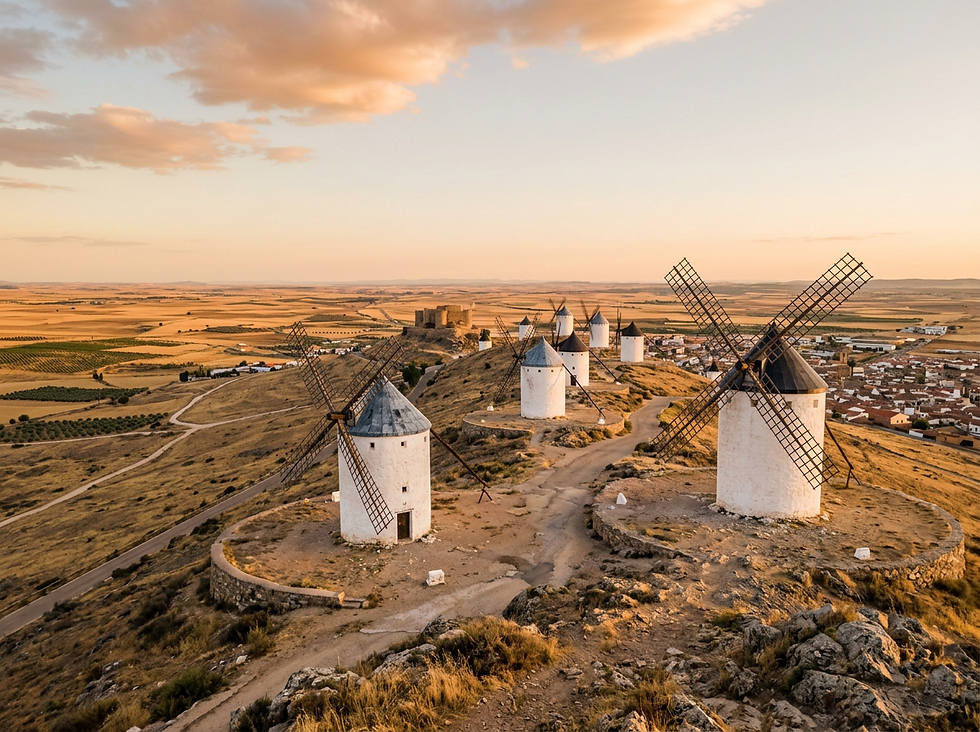
Consuegra is one of the most photographed windmill sites in Spain. A line of restored mills stands along a hill beside a castle, with open plains spreading out below. It is easy to visit, visually striking, and especially beautiful near sunset.
Some mills can be visited inside, depending on opening times. When the machinery is visible, the mills become more than scenery. You can see how grain, wind, wood, and stone came together in daily life.
Campo de Criptana feels close to Cervantes
Campo de Criptana is another key Don Quixote stop, with mills set above the town. The whitewashed houses and hillside setting give it a strong sense of place. This is one of the best locations if you want the literary connection without losing the feel of an actual working town.
Alcázar de San Juan links the route
Alcázar de San Juan is part of the wider Cervantes trail and works well as a practical stop between windmill sites. Its mills and museums help interpret the Quixote story and the culture of La Mancha.
If you plan a windmill route, do not treat it as a race. The beauty is in the pauses: a ridge at dusk, a quiet town square, a glass of local wine, a road that seems to run straight into the horizon.
Spend time in Almagro’s theatre town
Almagro is one of Castilla-La Mancha’s most graceful small towns. Its Plaza Mayor is the centrepiece, lined with distinctive green wooden galleries that give it a look unlike almost anywhere else in Spain.
The town is best known for theatre. Its historic Corral de Comedias is a rare surviving open-air theatre from Spain’s Golden Age. Almagro also hosts the International Classical Theatre Festival, which brings performances and cultural events to the town each year.
Even outside festival season, Almagro is worth a stop. It is compact, elegant, and easy to enjoy at a slow pace. Sit in the square, visit the theatre, try local aubergines, and let the afternoon stretch.
Look for the Black Villages of Guadalajara
For a moodier, less expected side of Castilla-La Mancha, head north into Guadalajara province. The Black Villages, including places such as Campillo de Ranas, are known for their dark slate architecture. Roofs, walls, lanes, and fences all seem to come from the same mountain material.
The effect is striking. After the pale stone of Toledo and the golden plains of La Mancha, these villages feel almost northern. On cloudy days, they can seem severe. In soft light, they are beautiful in a quiet, earthy way.
This area is best explored slowly, by car, with short walks between viewpoints and villages. The charm lies in texture rather than big monuments: stacked slate, narrow lanes, church towers, and hills that change colour with the weather.

Find colour at Ruidera and Brihuega
Castilla-La Mancha can look dry from the road, but its hidden places tell another story. Two of the best are the Lagunas de Ruidera and the lavender fields of Brihuega.
Paddle the Lagunas de Ruidera
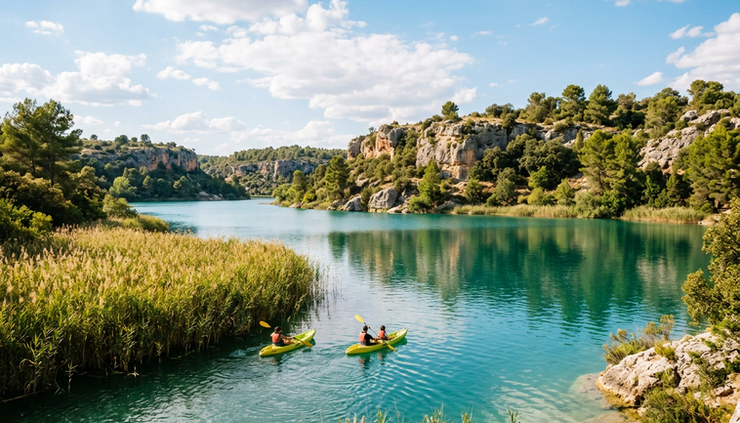
The Lagunas de Ruidera are often called the “Mirrors of La Mancha,” and the name fits. This chain of 15 lagoons forms a rare blue-green oasis between Albacete and Ciudad Real provinces. Waterfalls, reeds, cliffs, and clear shallows make the area feel far from the plains nearby.
In warm months, the lagoons are ideal for kayaking, paddleboarding, swimming in permitted areas, and gentle hiking. The water colour can be startling, shifting from turquoise to deep blue depending on the light.
Go early in the day if visiting in summer. The best experience is quiet water, birdsong, and enough time to stop between lagoons.
Walk through Brihuega’s lavender fields
In July, Brihuega and the surrounding Alcarria countryside turn purple with lavender. The fields draw comparisons with Provence, but the setting has its own Castilian character: broad skies, honey-coloured villages, and rows of flowers rolling across the hills.
The bloom depends on the season, so timing matters. Visit during July for the best chance of colour and scent. Late afternoon is especially rewarding, when the heat softens and the fields glow before sunset.
Explore Alcalá del Júcar and its cave houses
Alcalá del Júcar is one of the region’s most striking villages. Houses climb a limestone cliff above a curve in the Júcar River, and many are partly built into the rock. From across the water, the village looks carved rather than built.
The castle crowns the scene, while narrow streets wind through houses, viewpoints, and cave spaces. The river wraps around the town like a ribbon, adding reflections and shade. It is an excellent stop for travellers who like unusual architecture and compact places with strong character.
Give yourself time to climb. The best views come from above, but the lanes are steep. Afterward, return to the riverside for a slower look at the village from below.
Get outdoors in wild Castilla-La Mancha
The region is a strong choice for outdoor travel, especially if you like open space without heavy crowds. Hiking, cycling, birdwatching, and stargazing all fit naturally here.
Cabañeros is the “Spanish Serengeti”
Cabañeros National Park is often nicknamed the “Spanish Serengeti” because of its open plains and wildlife-rich areas. It protects Mediterranean forest, grassland, and hills where deer and birds of prey can be seen. Autumn is known for the deer rut, though the park has value in every season.
Guided visits can help, especially for wildlife watching. The distances are large, and local knowledge makes a difference.
Barranco del Río Dulce is made for walking and birds
Barranco del Río Dulce Natural Park offers gentler drama, with river canyons, cliffs, and walking routes. It is a good place for birdwatching, especially if you enjoy raptors and quiet trails.
Ruidera adds water sports in summer
When temperatures rise, the Lagunas de Ruidera become one of the best outdoor bases in the region. Kayaking, sailing, paddleboarding, and swimming can fill a summer day, as long as you follow local rules and protected-area guidance.
Build a route that gives the region room
Castilla-La Mancha looks simple on a map, but the best places are spread out. A good trip balances famous stops with quieter detours.
For a short break, pair Toledo and Consuegra. You get a World Heritage city and the classic windmill ridge without long detours.
For a richer route, add Cuenca and Almagro. This brings in cliffside drama, Renaissance charm, and a wider sense of the region’s history.
For a slower, more varied trip, include Ruidera, Alcalá del Júcar, Brihuega, or the Black Villages. These places show how much the region changes from one province to the next.
A simple one-week outline could look like this:
Day | Base or stop | Best focus |
1 | Toledo | Cathedral, old town, river viewpoints |
2 | Consuegra and Campo de Criptana | Windmills and Don Quixote scenery |
3 | Almagro | Plaza Mayor and historic theatre |
4 | Lagunas de Ruidera | Kayaking, walking, swimming in season |
5 | Alcalá del Júcar | Cave houses, castle, river views |
6 | Cuenca | Hanging Houses and gorge walks |
7 | Brihuega or Guadalajara villages | Lavender in July or black slate architecture |
Driving gives the most freedom, especially for villages, natural parks, and windmill ridges. Trains and buses connect some larger towns, but rural detours are harder without a car.
When to go and what to expect
Spring and autumn are the most comfortable seasons for walking, town-hopping, and photography. Summer can be hot across the plains, though it is also the season for water activities at Ruidera and lavender near Brihuega. Winter brings cold nights and quieter streets, with a more austere beauty in hill towns and slate villages.
Pack for contrasts. You may spend one day under strong sun on a windmill ridge and the next in a cool gorge or mountain village. Comfortable shoes matter more than polished outfits. So does water, especially on exposed walks and summer visits.
Food is hearty and local. Look for Manchego cheese, game dishes, stews, saffron, wines, and small-town specialities. Meals can be part of the route, not just a break from it.

The real magic is between the icons
The windmills may bring you to Castilla-La Mancha. Toledo and Cuenca may convince you to stay longer. But the region works best when you leave space for the places that sit between the famous names.
A slate village under low cloud. A kayak sliding across Ruidera’s clear water. A July evening in lavender fields. A cliffside town glowing above the Júcar River. These are the moments that make Castilla-La Mancha feel less like a route and more like a discovery.
Start with the must-sees, then take the side road. In this part of Spain, that is often where the best day begins.


Comments