
_edited.png)
Why Visit Castilla-La Mancha for Culture, Nature, and Don Quixote Trails

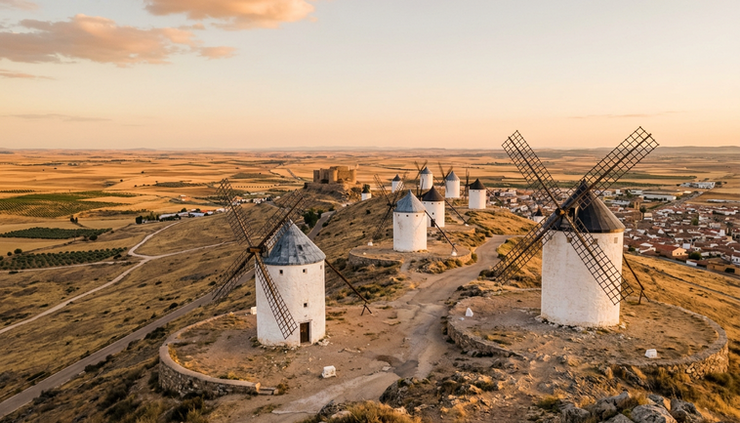
The visit of Castilla-La Mancha is often reduced to a single image: white windmills turning above a dry plain. That image is real, and it is unforgettable. Yet it is only the doorway into one of Spain’s richest inland regions.
This is a place where medieval streets still lead to synagogues, mosques, cathedrals, and fortresses. Roman ruins sit in open countryside. Monasteries rise from quiet towns. Wetlands, lagoons, waterfalls, river gorges, and wide vineyards give photographers more than enough reason to slow down.
For travellers who like culture with depth, nature with space, and routes built around a story, the visit to Castilla-La Mancha rewards time and curiosity.
Castilla-La Mancha turns Spanish history into something you can walk through
The region sits in the centre of Spain, south and east of Madrid, and its towns carry layers of Iberian, Roman, Visigothic, Muslim, Jewish, and Christian history. That mix gives Castilla-La Mancha its depth. You do not only visit monuments here. You move through streets where different cultures left visible marks.
Toledo gives the region its cultural centrepiece
Toledo is the obvious starting point, and for good reason. The city rises above a bend in the River Tagus, with stone walls, church towers, and narrow lanes packed onto a steep hill. It can feel compact at first, but every turn opens into another piece of history.
The Cathedral of Toledo is one of Spain’s great Gothic buildings, filled with chapels, carved stone, stained glass, and religious art. The Alcázar looks over the city from its high point. The old Jewish quarter adds another layer, with the Synagogue of Santa María la Blanca and the Synagogue of El Tránsito among its most important sights.
Toledo also keeps the memory of El Greco close. His long human figures and intense use of colour belong heavily to the city’s identity. Seeing his work here, rather than in a distant gallery, helps explain why Toledo became such a powerful subject for artists.
The pleasure of Toledo is not only in picking off landmarks. It is in walking early or late, when the day-trippers thin out and the stone lanes grow quieter. The city has viewpoints across the river too, which are ideal at sunset.
Cuenca feels built for slow looking
Cuenca, also a UNESCO-listed city, has a different mood. Its old town sits high between the gorges of the Júcar and Huécar rivers, with houses clinging to rock and narrow streets climbing towards the upper town.
The famous hanging houses, known as casas colgadas, are the image most people remember. They appear to lean out above the gorge, almost daring the city to float. Nearby, the bridge of San Pablo gives one of the best views, especially for photography.
Cuenca also has a serious cultural side. Its cathedral combines Gothic origins with later additions, and the old town has museums, convents, small squares, and lookout points that make it easy to spend a full day without rushing.
Where Toledo can feel grand and dense, Cuenca feels vertical and dramatic. Both belong on a culture-focused itinerary, but they offer very different versions of Castilian history.

Smaller towns reveal the region’s quieter treasures
The major cities may draw the attention, but Castilla-La Mancha often feels most rewarding in smaller places. These are the stops where the pace changes, parking is easier, and the cultural sites feel closely tied to the surrounding countryside.
Segóbriga is one of the best examples. This Roman archaeological site preserves the remains of a theatre, amphitheatre, baths, streets, and city walls. Its setting makes it especially memorable. Rather than standing in the middle of a modern city, the ruins sit in open land, which makes the former Roman settlement easier to imagine.
Uclés offers another kind of history. Its monastery, often linked with the Order of Santiago, dominates the town from above. The complex has the scale and confidence of a major religious and military site, but without the crowds that often come with better-known monuments.
Other towns across the region add castles, parish churches, plazas, and traces of frontier history. The old borderlands between Christian and Muslim powers shaped many hilltop settlements. That is why fortresses appear so often in the region, and why so many towns look towards the horizon from a defensive position.
For a culture-led trip, it helps to mix famous places with smaller ones. A good route might pair Toledo with Consuegra, Cuenca with Segóbriga, or Uclés with nearby villages and countryside. This keeps the trip varied and prevents cathedral fatigue, which is a real risk in a region so rich in religious architecture.
Nature in Castilla-La Mancha is more varied than many expect
The central Spanish plateau can look dry and severe at first glance. Give it time, and the natural side of the region starts to open up. Water appears in surprising places. Gorges cut through limestone. Wetlands bring birds and reeds. Lagoons shift from blue to green depending on light and season.
For nature lovers and photographers, this variety is one of the best reasons to stay longer.
Ruidera Lakes Natural Park brings water into the heartland
Ruidera Lakes Natural Park is one of Castilla-La Mancha’s most appealing natural areas. Its chain of 16 linked lagoons, with small waterfalls and clear water between them, feels unexpected in such a dry region.
The park spreads across a series of lakes and surrounding vegetation, with viewpoints, walking paths, and places to stop near the water. The colours change through the day. Morning can bring softer reflections, while late afternoon gives stronger contrast against the pale rock and scrub.
It is a strong choice for travellers who want variety without extreme hiking. You can plan a gentle day around viewpoints and short walks, or spend more time exploring the lakes in detail. In warmer months, the area becomes busier, so early starts are worth it.
Tablas de Daimiel offers boardwalks through wetlands
Tablas de Daimiel National Park protects one of Spain’s notable wetland areas. Its boardwalks make the park easy to explore, even for visitors who do not want a long or difficult walk.
The appeal here is quiet observation. Reeds, shallow waters, open sky, and birdlife create a very different atmosphere from the hill towns and dry plains elsewhere in the region. Photographers will find strong lines in the wooden walkways, reflections in still water, and changing light across the marsh.
As with any wetland, conditions can vary by season and rainfall. That said, the park remains an important reminder that Castilla-La Mancha is not only windmills and fields. It also has fragile water systems that deserve careful attention.
Barranco del Río Dulce gives the region drama
For a more rugged scene, Barranco del Río Dulce offers cliffs, river bends, and walking routes through a dramatic gorge. It lies in the province of Guadalajara and feels wilder than many visitors expect from central Spain.
This is the kind of place where scale matters. Rock walls rise above the river, birds move across the cliffs, and paths follow the shape of the gorge. It suits travellers who like open-air days with a sense of space, but who also want a location that feels distinct from classic mountain scenery.
Bring water, sun protection, and shoes with grip. The region’s climate can be harsh in summer, and exposed walking routes are always more enjoyable when planned around the cooler parts of the day.

Don Quixote trails give the journey a story
Few literary characters are tied to a region as strongly as Don Quixote is tied to La Mancha. Cervantes turned the plains, roads, inns, villages, and windmills of this area into an imaginative stage. Travelling here gives the book a physical setting.
A Don Quixote route can be as simple or as detailed as you like. The classic stops include Consuegra, Campo de Criptana, and Alcázar de San Juan, all known for their links to windmills and Manchegan identity.
Consuegra combines windmills with a castle ridge, so it works especially well for photos. The line of white windmills above the plain is at its best in low light, when shadows give shape to the hill. Campo de Criptana has some of the most iconic windmills in La Mancha and often feels closest to the literary image many travellers carry in their minds. Alcázar de San Juan adds another useful stop, especially if building a wider route through the region.
The key is not to treat the windmills as a quick photo exercise. They make more sense when paired with the broader setting: dry plains, big skies, small towns, local food, and the feeling of distance between places. That geography helps explain why Don Quixote’s imagined adventures still fit the region so well.
For a satisfying route, try this pattern:
Spend a night in Toledo or a nearby town before heading into La Mancha.
Visit Consuegra early or late for the best light.
Continue to Campo de Criptana for another windmill setting.
Add Alcázar de San Juan or El Toboso if time allows.
Leave room for a long lunch, because rushing defeats the point.
This kind of trip works well by car. Public transport can connect larger towns, but rural stops are easier when you can set your own pace.
Wine country adds flavour to the route
Castilla-La Mancha is one of Spain’s major wine regions, with wide vineyard areas that stretch across open country. Wine tourism here tends to feel less polished than in some famous regions, which can be part of the appeal. The experience is often about scale, local producers, harvest rhythms, and simple food that matches the climate.
The region is especially known for Airén, a white grape long associated with central Spain, along with Tempranillo and other varieties. Modern producers have raised quality across many areas, so it is worth looking beyond old assumptions about bulk wine.
A wine-focused itinerary can sit neatly alongside culture and literature. You might visit Toledo, follow windmill towns across La Mancha, then add vineyard visits or harvest events where available. Around late summer and early autumn, harvest season can bring a different energy to wine villages, though exact timing varies each year.
Keep the plan realistic. Distances can be larger than they look on a map, and wine visits often need booking ahead. If tasting, choose a designated driver or arrange local transport.

How to plan a balanced Castilla-La Mancha itinerary
The best trip through Castilla-La Mancha combines three strands: culture, nature, and themed routes. Focusing on only one can work, but the region becomes more interesting when the days have contrast.
For a short break of three or four days, choose one main base and build out from it. Toledo works well if culture is the priority. Cuenca is ideal if you want architecture and gorge views. A windmill-focused trip is easier with a car and a route through the towns of La Mancha.
For a week, the region opens up. You could plan a route like this:
Day | Focus | Good base or stop |
1 | Toledo’s cathedral, Jewish quarter, and viewpoints | Toledo |
2 | Consuegra windmills and castle | Toledo or La Mancha town |
3 | Campo de Criptana and Alcázar de San Juan | La Mancha |
4 | Ruidera Lakes Natural Park | Ruidera area |
5 | Tablas de Daimiel or wine country | Daimiel or nearby |
6 | Cuenca old town and hanging houses | Cuenca |
7 | Segóbriga or Uclés | Route back towards Madrid |
Spring and autumn are often the most comfortable seasons for walking, sightseeing, and photography. Summer can be very hot, especially in exposed towns and open plains. Winter is quieter and can be atmospheric, but daylight is shorter and some rural services may be limited.
Food should be part of the plan too. Look for Manchego cheese, rustic stews, game dishes where typical, local wine, saffron, and simple breads. Meals here often match the region’s character: hearty, direct, and tied to the land.
The real reason to go
Castilla-La Mancha rewards travellers who enjoy places with space between them. It does not always reveal itself in one quick stop. Its appeal builds across a route: Toledo at dusk, Cuenca above its gorge, Roman stones at Segóbriga, windmills on a ridge, reeds moving in a wetland, vines stretching across dry soil.
Visit for the windmills, certainly. They are worth the journey. But stay for the mix of cultures, the quiet towns, the unexpected water, and the feeling that literature, history, and geography still speak to each other here.


Comments